Concrete That Looks Finished, Not Patched
Concrete repair and restore in New Jersey & Pennsylvania for surfaces showing cracking, spalling, discoloration, or structural deterioration
Existing concrete slabs, steps, driveways, and flatwork carry visible evidence of how they were originally poured and how long they have been in service — surface scaling, hairline fractures, and aggregate exposure are all readable conditions that point to specific repair approaches. Re-new Masonry performs concrete repair and restoration work on existing concrete surfaces, working with what is already in place rather than removing and replacing it. The result is a surface that reads as finished and intentional, not as a patchwork of emergency fixes applied over time.
The process begins with reading the existing surface: identifying whether damage is purely cosmetic, whether it has compromised the substrate layer, and whether the concrete beneath the failed surface is still structurally sound enough to bond with repair material. That assessment drives every material and technique decision that follows. Re-new Masonry's renew-crete process works directly on the existing slab — cleaning, profiling, and applying restorative material to produce a continuous, cohesive surface that functions as an integrated finish rather than a visible repair.
Arrange an on-site evaluation to review the current condition of your concrete and identify which restoration approach applies to your specific surfaces.

What Proper Concrete Restoration Actually Requires
Surface preparation is the factor that separates restoration work that lasts from work that fails within a season. The existing concrete must be clean, free of laitance, and mechanically profiled so that repair material has a surface to bond with. Skipping or rushing that step is the single most common reason resurfacing products delaminate — the overlay cures correctly, but has nothing to hold onto because the substrate was never properly opened. The prep work is slower and less visible than the application itself, which is why it tends to be shortchanged on lower-quality jobs.
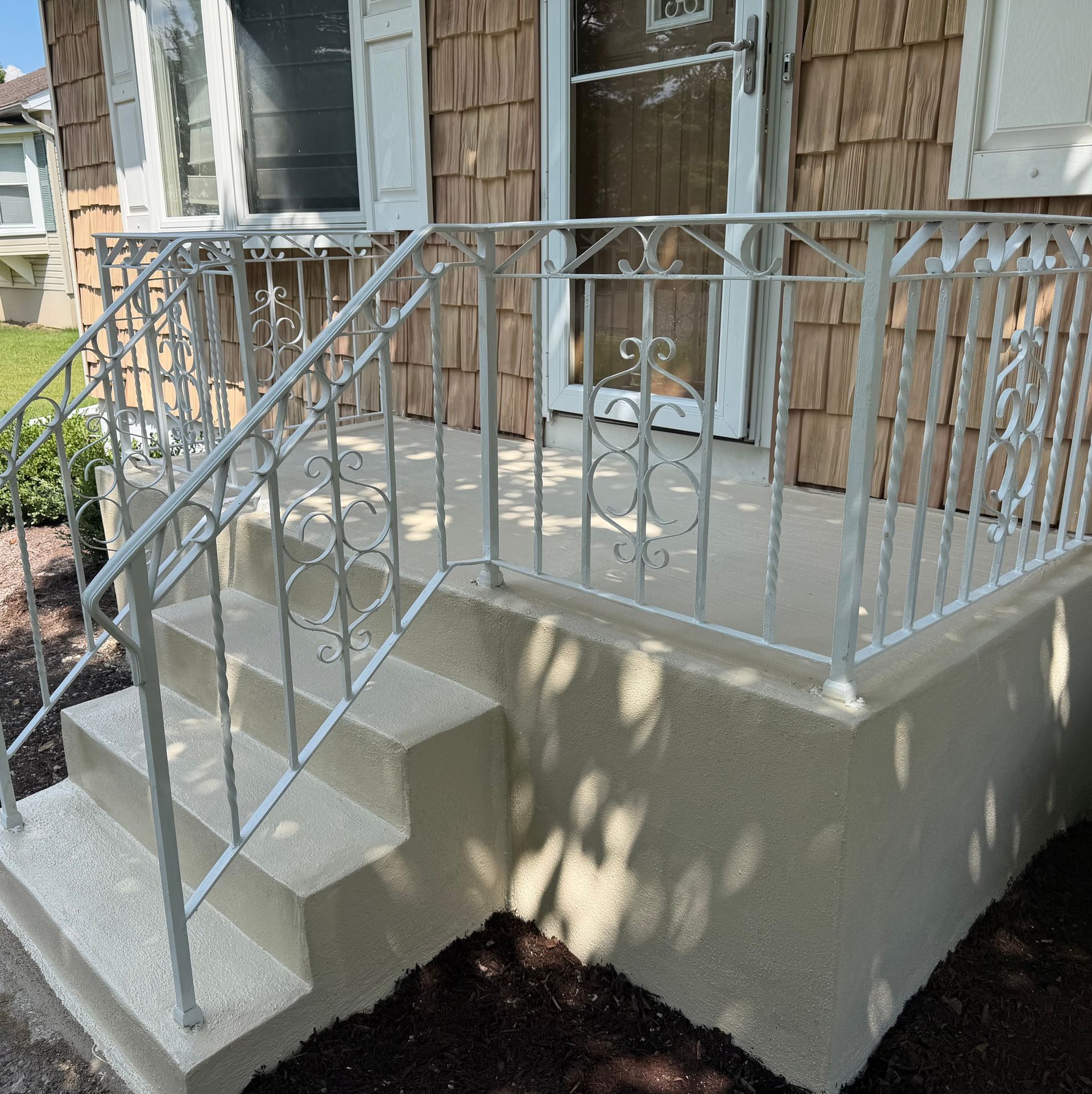
Once the surface is prepared and any structural cracks or spalls are addressed at the substrate level, the restorative material is applied across the existing slab. What you notice when the work is finished is a surface that reads as a single continuous plane — no visible patch lines, no color mismatch between repaired zones and surrounding areas, and no edges where a repair product has been feathered over an unprepared section. Re-new Masonry's approach through the renew-crete process targets exactly that continuity, working to make the repaired surface indistinguishable from what a properly finished slab would have looked like from the start.
The scope of restoration work varies depending on the depth of the existing damage. Surface-level scaling and discoloration sit in a different category than cracks that have moved through the full slab thickness or areas where the concrete has lost integrity at the base. Understanding which condition is present determines whether restoration is the appropriate solution or whether sections need to be addressed differently before any surface work begins.
What Property Owners Ask About the Work
Concrete restoration raises practical questions about process, durability, and what the finished surface will actually look like. The following covers what property owners consistently want to understand before the work begins.
- What does surface preparation for concrete restoration involve? Preparation typically includes pressure washing, removal of any loose or deteriorated material, mechanical grinding or scarifying to open the surface profile, and cleaning to remove contaminants that would interfere with adhesion. The depth of preparation depends on how far the surface damage extends into the slab.
- How is a structural crack handled differently from a hairline surface crack? Hairline cracks that have not moved through the full slab thickness are typically cleaned, filled, and incorporated into the surface restoration. Cracks that show vertical displacement or that extend through the slab require repair at the substrate level before any restorative overlay is applied, because applying a surface product over an active or deep crack will not stop the crack from reflecting through the new material.
- What makes restorative material bond permanently to existing concrete? Mechanical surface profiling — grinding or scarifying the existing slab — creates a textured substrate that gives the repair material something to grip. Chemical bonding agents are often applied after profiling to further improve adhesion between the old concrete and the new material. Both steps matter; relying on one without the other reduces long-term bond strength.
- Why do some concrete repairs show patch lines while others disappear? Patch lines appear when repair material is applied only to the damaged zone without feathering or blending into surrounding sections, or when the color mix of the repair product does not match the existing concrete. Full-surface restoration work eliminates that problem by treating the entire surface as a single plane rather than addressing only the visibly damaged areas.
- When is concrete restoration the right choice rather than full replacement? Restoration is appropriate when the underlying slab is structurally intact and the damage is concentrated in the top surface layer. If the slab has settled unevenly, has extensive base failure, or has sections that have lost structural integrity, those conditions need to be evaluated before determining whether restoration or replacement is the correct path forward.
Re-new Masonry focuses specifically on repair and restoration of existing concrete — not replacement pours or new flatwork installations. To understand which repair approach fits your current surface conditions, request a surface assessment so the existing concrete can be evaluated directly before any work is scoped.

